
Article
Decision Intelligence is increasingly moving from a specialist discipline into the enterprise technology landscape. In 2026, Gartner introduced a Magic Quadrant specifically for Decision Intelligence Platforms, describing platforms that combine decision modelling, analytics and AI capabilities to support, augment and automate decision-making.
For aviation, however, the significance is not the arrival of another technology label.
It is the increasing focus on the decision itself.
Airlines already operate with sophisticated forecasting, optimisation, analytics, operational control and automation capabilities. The interesting question is what happens when we examine those capabilities explicitly from the perspective of the decisions an airline needs to make.
Airlines are decision environments
Consider a delayed inbound aircraft.
Predicting its arrival time accurately is valuable. So is identifying the passengers at risk of missing their connections.
But neither prediction, by itself, determines what the airline should do.
Should a connecting flight wait?
Should affected passengers be rebooked immediately?
What are the consequences for the next aircraft rotation?
Could crew constraints become relevant?
What happens to the passengers already booked on the connecting flight?
Could a different gate or operational action reduce the impact?
What are the implications for baggage, slots, operational cost and customer experience?
And at what point does protecting one part of the operation create a larger problem somewhere else?
These are not simply data questions.
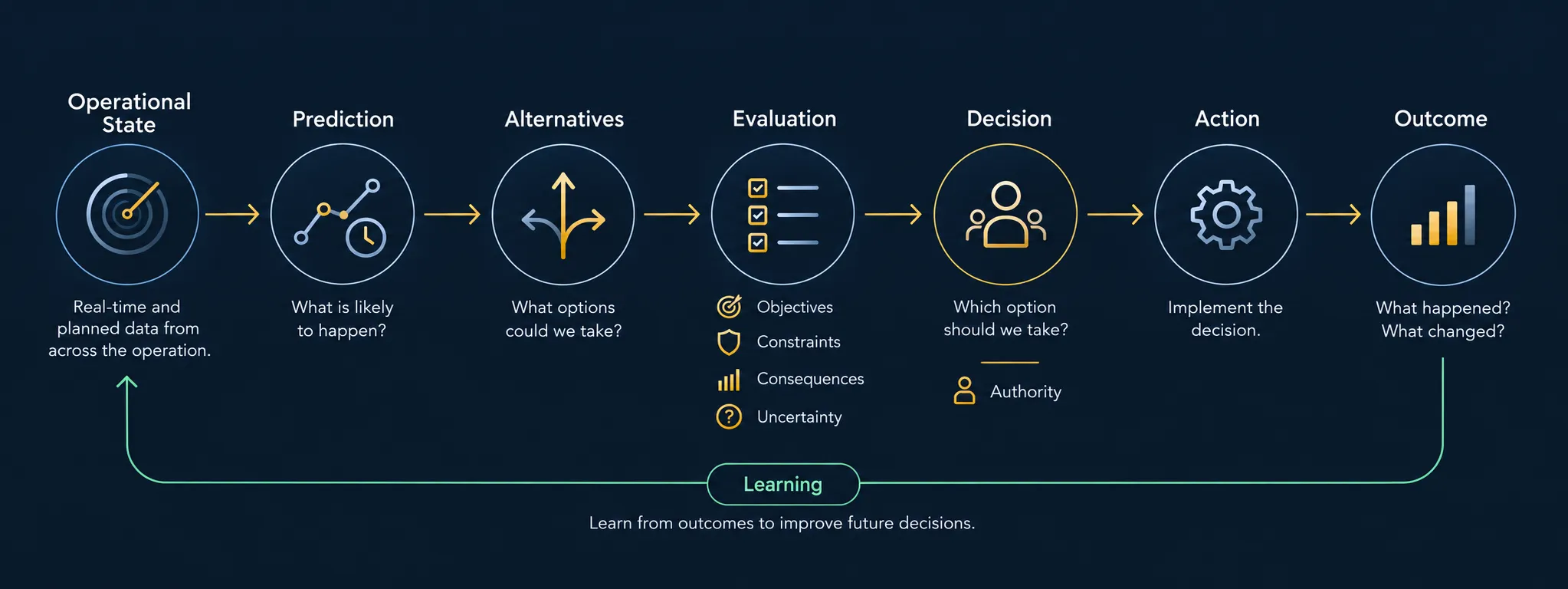
They are decision questions involving alternatives, objectives, constraints, consequences, uncertainty and authority.
That distinction matters.
Prediction is valuable. But a prediction is not a decision.
Machine learning has substantially expanded our ability to predict operational events.
An airline may be able to predict that an aircraft will arrive late, that a passenger connection is at risk, or that a turnaround is likely to exceed its planned duration.
These predictions can be extremely valuable.
But knowing what is likely to happen and determining what should be done about it are different problems.
The latter requires identifying possible actions and evaluating their consequences against operational objectives and constraints.
Sometimes optimisation can provide part of the answer.
Sometimes established business rules determine the available choices.
Sometimes several operational domains must coordinate.
Sometimes human judgement remains essential.
And frequently several of these mechanisms coexist.
Decision Intelligence provides a useful perspective because it places the decision — rather than a particular algorithm, model or technology — at the centre of the problem.
The challenge is not simply more AI
This distinction becomes increasingly important as generative and agentic AI enter enterprise technology.
It is tempting to frame every operational problem as an AI problem.
But an airline decision environment is broader than any single technology.
Operations Research has decades of experience addressing complex optimisation, scheduling and resource-allocation problems.
Machine learning can improve prediction.
Causal inference provides methods for reasoning about interventions and their effects.
Simulation can explore possible operational futures.
Process mining can help reveal how processes actually behave.
Rules can represent operational, business and regulatory constraints.
Human operators contribute contextual understanding, experience, accountability and judgement.
Decision Intelligence does not make these disciplines obsolete.
The more interesting question is how these different capabilities can contribute coherently to better decisions.
Airline operations make this particularly demanding
Airline operations are highly interconnected.
Aircraft, crew, passengers, baggage, airports, maintenance, slots and network schedules do not operate independently.
A decision taken in one domain can propagate into several others.
A choice that improves punctuality for one flight may affect passenger connectivity. Protecting a connection may influence the following aircraft rotation. An aircraft change may resolve one operational constraint while creating crew, maintenance or passenger consequences elsewhere.
The objectives themselves can also conflict.
Operational performance matters.
So do cost, revenue, connectivity, customer impact, resource utilisation and resilience — within safety, regulatory and operational constraints.
This means that the difficult problem is not necessarily finding the locally optimal action.
It is understanding which decision should be taken, in which context, against which objectives and constraints, with which expected consequences, and under whose authority.
That is a much richer problem than deploying another predictive model.
Adopt before invent
There is another important consequence.
Aviation, like many industries, has a tendency to create industry-specific terminology around emerging technologies.
Sometimes that is justified. Airline operations contain domain-specific structures, constraints and decision problems.
But new terminology should not substitute for understanding what already exists.
Decision Intelligence is not the only discipline relevant to these questions. Operations Research, decision theory, causal inference, reinforcement learning, control theory, process mining and other established fields contain substantial bodies of knowledge related to decision-making, optimisation, uncertainty, learning and control.
Before proposing an aviation-specific concept, architecture or methodology, we should therefore ask a simple question:
Has this problem already been addressed elsewhere?
If it has, the sensible starting point is to adopt that knowledge and determine how it needs to be adapted to the airline environment.
Only where existing approaches prove insufficient should something new be proposed.
In short:
Adopt before invent.
That principle is particularly important in the current AI environment, where new terminology can emerge faster than the underlying disciplines evolve.
From Decision Intelligence to airline operational reality
Applying established Decision Intelligence thinking to airline operations raises difficult questions.
What exactly constitutes an operational decision?
How should alternatives and their expected consequences be represented?
How should we evaluate the quality of a decision separately from its eventual outcome, particularly when decisions are made under uncertainty?
How should decisions across different operational domains interact?
How should conflicting objectives be handled?
What information should be available at the moment a decision is made?
When should a machine inform, recommend or act — and when should authority remain with a human?
How should decisions and their outcomes be recorded?
And under what conditions can those outcomes improve future decisions?
These questions cannot be answered simply by selecting an AI model.
They require us to examine the decision-making system itself.
Project Altitude
These are some of the questions behind Project Altitude.
Altitude is an ACC research initiative examining how established Decision Intelligence principles can be applied — and, only where the evidence requires it, extended — to airline operational decision-making.
The objective is not to create another AI discipline or another vocabulary for concepts that already exist.
The starting point is the opposite.
The research examines established Decision Intelligence and adjacent disciplines, tests their applicability against the operational reality of airlines, and seeks to distinguish between three things:
What can be adopted.
What needs to be adapted.
And what, if anything, remains genuinely unresolved.
That distinction matters.
Because progress in airline AI should not be measured by how many new concepts we can name.
It should ultimately be measured by whether airlines can make better decisions.
Follow the research
This article begins a series exploring Decision Intelligence in airline operations.
Future articles will examine questions including decision quality, decision authority, human-machine collaboration, decision memory, cross-domain coordination and the relationship between prediction, optimisation and operational action.
The approach will remain evidence-first: established knowledge before new terminology, and research questions before claims.
The objective is not to start with the answer.
It is to make the questions precise enough that the answers can be tested.
Project Altitude — exploring Decision Intelligence in the operational reality of airlines.
References & Further Reading
- Gartner — Magic Quadrant for Decision Intelligence Platforms (2026)
Published 26 January 2026. Gartner describes Decision Intelligence Platforms as combining decision modelling, analytics and AI capabilities to support, augment and automate decision-making.
- Gartner — Critical Capabilities for Decision Intelligence Platforms (2026)
Published 27 January 2026. Companion research examining capabilities and use cases within the emerging Decision Intelligence Platform category.